
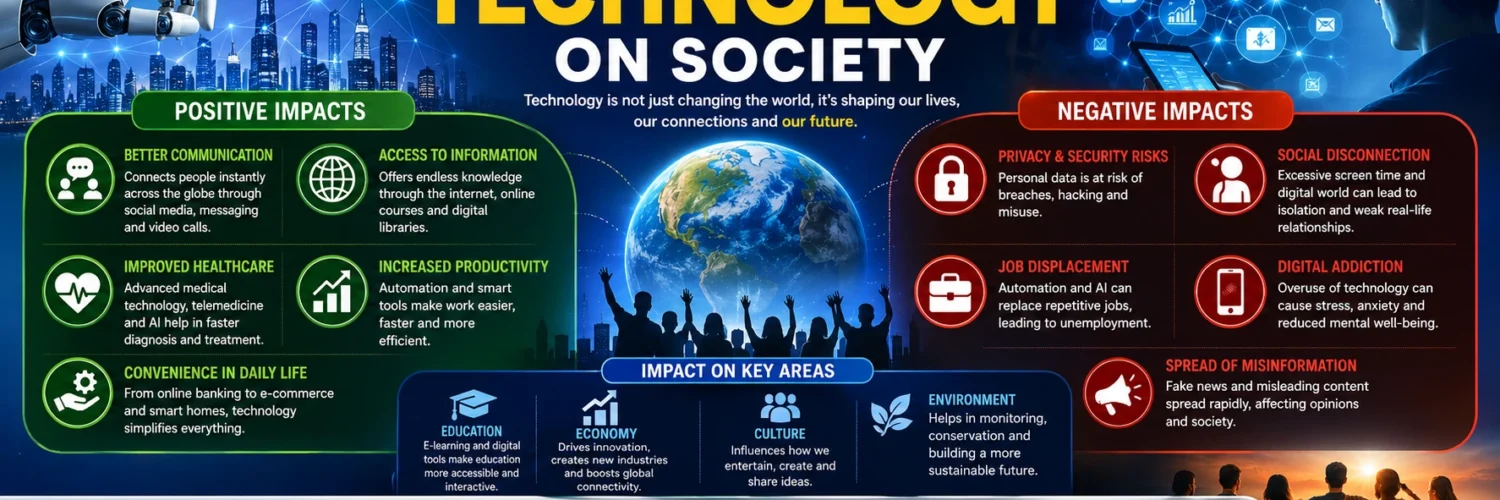

Technology has transformed society by improving communication, healthcare, education, and business. However, it also raises concerns about privacy, job displacement, misinformation, and digital addiction. Its global impact is both positive and negative, depending on how responsibly individuals, organizations, and governments develop, regulate, and use technological innovations.
The impact of technology on society is both good and bad it depends on how it’s used. Technology has improved healthcare, education, and communication worldwide, but it has also created problems like job loss, addiction, privacy risks, and growing inequality. The real question isn’t whether technology is good or bad, but whether we’re using it responsibly.
Ask ten different people whether technology has been good or bad for the world, and you’ll probably get ten different answers. Your grandmother might say phones have made families distant. A doctor might say the same phone saved a patient’s life through a telemedicine call. A teenager might say social media ruined their focus, while a student in a remote village might say the internet gave them access to an education they’d never have had otherwise.
The truth is, both of these views are correct at the same time. That’s what makes the impact of technology on society such a complicated and honestly fascinating topic to unpack. In this article, we’ll walk through what technology in society actually means, look at the real positives and negatives, and answer the most common questions people search for on this subject.
What Is Technology in Society?
Before getting into whether it’s “good” or “bad,” it helps to understand what we actually mean by technology in society. Technology isn’t just smartphones and computers. It includes:
- Communication tools (phones, internet, social media)
- Medical equipment and pharmaceutical advances
- Transportation systems (cars, planes, electric vehicles)
- Industrial and manufacturing machinery
- Artificial intelligence and automation software
- Agricultural technology used to grow and distribute food
In short, technology is any tool, system, or process created by humans to solve a problem or make life easier. Society, in turn, shapes how that technology is built, adopted, and used which is why the relationship between the two goes both ways.
How Does Society Affect the Use of Technology?
This is a question people don’t ask often enough, but it matters. Technology doesn’t develop in a vacuum society decides what gets built, funded, banned, or normalized.
For example:
- Cultural values influence what kind of technology gets adopted. Some countries embrace facial recognition in public spaces; others restrict it over privacy concerns.
- Economic conditions determine who has access. A new technology may be common in wealthy nations while remaining out of reach in developing ones.
- Government policy can accelerate or slow down innovation, from subsidizing renewable energy tech to restricting AI development.
- Public demand drives companies to build what people are willing to pay for or share online.
So while we often talk about the impact of technology on society, it’s really a two-way relationship society is constantly shaping the very technology that then shapes it back.
The Global Impact of Technology on Society: An Overview
When people search for “the global impact of technology on society good or bad,” they’re usually trying to understand the bigger picture not just how one gadget affects one person, but how technology as a whole has reshaped human life across the planet.
Globally, technology has:
- Connected over 5 billion people to the internet
- Cut the cost of long-distance communication to nearly zero
- Made remote work and global business collaboration possible
- Enabled real-time access to news, education, and emergency information
- Accelerated medical research, including vaccine development
- Automated dangerous or repetitive labor in factories and mines
At the same time, it has introduced new global-scale problems cybercrime, misinformation, digital surveillance, and environmental costs from e-waste and data centers. This dual nature is exactly why the debate over whether technology’s impact is good or bad continues, without a clean answer.
Positive Impact of Technology on Society
Let’s start with the upside, because there’s a lot of it.
1. Better Access to Healthcare
Technology in medicine has been genuinely life-saving. MRI machines, robotic surgery, telemedicine apps, and AI-assisted diagnosis tools have made healthcare faster, more accurate, and more accessible especially for people in rural or underserved areas who can now consult a doctor over video call instead of traveling for hours.
2. Education Without Borders
A student in a small town can now take a free course from a top university halfway across the world. Online learning platforms, digital libraries, and translation tools have broken down barriers that once limited education to those who could afford it or live near it.
3. Economic Growth and New Jobs
While technology has eliminated some jobs, it has also created entirely new industries app development, digital marketing, data science, and cybersecurity, to name a few. E-commerce alone has allowed small businesses to sell products globally without needing a physical storefront.
4. Instant Communication
Families separated by continents can have a video call in seconds. Businesses can coordinate across time zones in real time. This kind of connection was unimaginable just a few decades ago.
5. Disaster Response and Safety
GPS tracking, early warning systems, and satellite imaging now help predict natural disasters, coordinate rescue efforts, and save lives during emergencies.
What Are 5 Positive Impacts of ICT on Society?
Information and Communication Technology (ICT) specifically has reshaped daily life in these five major ways:
| ICT Impact | Real-World Example |
|---|---|
| Faster communication | Instant messaging, video calls |
| Access to information | Search engines, online encyclopedias |
| Remote work capability | Cloud tools, video conferencing |
| Digital financial services | Mobile banking, online payments |
| E-learning opportunities | Online courses, virtual classrooms |
These five points are often what educators and students look for when covering the impact of technology on society speech or essay assignments, since they represent measurable, real-world benefits.
Negative Impact of Technology on Society
Now for the other side of the coin because pretending technology is only beneficial would be dishonest.
1. Job Displacement Through Automation
Factories, warehouses, and even customer service roles are increasingly automated. While new jobs are created, the transition often leaves workers especially in manufacturing without the skills needed for the new roles available.
2. Mental Health Concerns
Constant exposure to social media has been linked to anxiety, low self-esteem, and sleep problems, particularly among teenagers. The pressure to stay constantly connected and compare oneself to curated online lives takes a real psychological toll.
3. Privacy and Data Security Risks
Every app, website, and smart device collects data. Data breaches, identity theft, and unauthorized surveillance have become genuine global concerns, with personal information often traded or sold without users fully understanding it.
4. Widening Digital Divide
Not everyone has equal access to technology. While some regions enjoy high-speed internet and the latest devices, others still lack reliable electricity, let alone broadband. This gap in access often deepens existing social and economic inequality.
5. Environmental Damage
Manufacturing electronics, running massive data centers, and disposing of e-waste all carry environmental costs. Ironically, some of the tools meant to make life easier are also contributing to climate and pollution problems.
What Are 5 Negative Impacts of Technology?
To summarize clearly, the five most commonly cited negative impacts of technology are:
- Job loss due to automation
- Increased screen addiction and reduced attention span
- Privacy invasion and data misuse
- Social isolation despite increased “connection”
- Environmental harm from production and e-waste
These points frequently come up in any impact of technology on society essay, group discussion, or classroom debate, because they represent tangible, well-documented consequences rather than abstract fears.
Impact of Technology on Society: Positive and Negative Side by Side
| Category | Positive Impact | Negative Impact |
|---|---|---|
| Communication | Instant global connection | Reduced face-to-face interaction |
| Healthcare | Faster diagnosis, telemedicine | Over-reliance on machines |
| Education | Access to global resources | Shortened attention spans |
| Employment | New tech industries | Displacement of traditional jobs |
| Economy | Global trade, e-commerce growth | Widening wealth gap |
| Environment | Smart energy solutions | E-waste and carbon emissions |
| Privacy | Convenient digital services | Data breaches and surveillance |
This kind of side-by-side comparison is often exactly what’s needed for a technology and society impact of technology on society assignment, presentation, or debate prep it shows both perspectives clearly without leaning too far in either direction.
Impact of Science and Technology on Society
Science and technology are closely linked, but they’re not identical. Science is the pursuit of understanding how things work. Technology is the application of that understanding, turning knowledge into tools.
Together, they’ve reshaped nearly every part of modern life:
- Vaccines and antibiotics have added decades to average human lifespans.
- Renewable energy science has led to solar panels and wind turbines now powering entire cities.
- Space technology, born from decades of scientific research, now gives us weather forecasting, satellite internet, and GPS navigation.
- Agricultural science combined with modern equipment has dramatically increased food production, helping to feed a growing global population.
The impact of science and technology on society, taken together, is arguably one of the biggest reasons human life expectancy, literacy, and overall quality of life have improved so dramatically over the past century.
The Impact of Digital Technologies on Everyday Life
Digital technologies specifically smartphones, apps, cloud computing, and AI have changed daily routines in ways older generations never experienced.
Consider a normal day for many people today:
- Waking up to a smartphone alarm
- Checking messages and news within minutes of waking
- Using GPS to navigate to work
- Paying for coffee with a tap instead of cash
- Attending a meeting via video call instead of traveling
- Streaming entertainment instead of watching scheduled TV
- Ordering dinner through an app instead of calling a restaurant
Every one of these small moments reflects how deeply digital technology has embedded itself into ordinary life often so smoothly that we don’t even notice the shift until it’s pointed out.
The Global Impact of Technology on Society: Good or Bad Wikipedia-Style Overview
If you’re looking for a neutral, encyclopedia-style summary (the kind often searched as “the global impact of technology on society good or bad wikipedia”), it typically breaks down like this:
- Economic impact: Increased productivity and global trade, alongside job market disruption.
- Social impact: Greater connectivity and access to information, alongside concerns about mental health and social isolation.
- Environmental impact: New tools for sustainability, alongside pollution and resource consumption from production.
- Political impact: Wider civic participation through digital platforms, alongside risks of misinformation and surveillance.
This balanced structure is useful for research papers, essays, and general reference, because it avoids picking a side and instead presents technology’s impact as multi-dimensional.
Impact of Technology on Society: Group Discussion Points
If you’re preparing for a group discussion or debate on this topic, here are some solid discussion angles:
- Is technology making us more productive or more distracted?
- Should governments regulate AI more strictly to protect jobs?
- Does social media bring people together or push them apart?
- Is the digital divide a bigger threat to equality than economic inequality itself?
- Can technology help solve the environmental problems it helped create?
These questions work well for the impact of technology on society speech, classroom debates, or interview-style discussions because they don’t have a single “correct” answer they invite genuine back-and-forth.
Conclusion: So, Is It Good or Bad?
After looking at all of this, the honest answer is that technology itself is neutral it’s a tool. A hammer can build a house or break a window; the outcome depends entirely on how it’s used. The same logic applies to smartphones, AI, automation, and every other piece of modern technology.
The global impact of technology on society is a mix of extraordinary progress and genuine new challenges. It has cured diseases and connected strangers across oceans, while also displacing workers and creating new mental health struggles. The real responsibility falls on individuals, companies, and governments to use these tools thoughtfully, pushing for the benefits while actively working to reduce the harms.
Rather than asking “is technology good or bad,” a more useful question might be: are we using it wisely?
Frequently Asked Questions (FAQs)
1. What are 5 negative impacts of technology?
Job loss from automation, reduced attention spans, privacy risks, social isolation, and environmental damage from e-waste and energy use.
2. What are 5 positive impacts of ICT on society?
Faster communication, easier access to information, remote work capability, digital financial services, and expanded e-learning opportunities.
3. What is technology in society?
Technology in society refers to the tools, systems, and processes from smartphones to medical equipment that humans create and use to solve problems and improve daily life.
4. How does society affect the use of technology?
Society shapes technology through cultural values, economic conditions, government policy, and consumer demand, determining what gets built, adopted, or restricted.
5. Is the impact of technology on society mostly positive or negative?
It’s genuinely mixed. Technology has improved healthcare, education, and communication, but it has also introduced job displacement, privacy risks, and mental health concerns.
6. What is the impact of science and technology on society?
Combined, science and technology have increased life expectancy, improved food production, expanded access to clean energy, and enabled major advances in medicine and communication.
7. How has digital technology changed everyday life?
Digital technology now touches nearly every daily activity from waking up with a smartphone alarm to paying bills, navigating with GPS, and working remotely via cloud tools.
8. What is the biggest negative impact of technology on society today?
Impact of technology on Society Many experts point to the widening digital divide and data privacy risks as two of the most pressing concerns, alongside the mental health effects of constant connectivity.
9. Can technology help fix the problems it created, like pollution?
Yes, renewable energy technology, Impact of technology on Society AI-driven efficiency systems, and recycling innovations are actively being developed to reduce technology’s own environmental footprint.
10. Why is the impact of technology on society considered both good and bad?
Because technology amplifies whatever it’s used for, it can educate or distract, connect or isolate, heal or harm, depending entirely on how individuals and societies choose to apply it.
About the Author
This article was researched and written to provide a balanced, easy-to-understand overview of how technology affects society globally, drawing on widely available research and commonly discussed perspectives on the topic.
Add comment